2 - You Are Locked In
Explore the foundational idea that we are each permanently locked into our own subjective perception of reality. This episode unpacks what it truly means to be at the center of your experience, the limitations of shared reality, and the implications for how we live and connect with others.
This show was created with Jellypod, the AI Podcast Studio. Create your own podcast with Jellypod today.
Get StartedIs this your podcast and want to remove this banner? Click here.
Chapter 1
The Epistemic Condition of Consciousness
Toye Oyelese
Welcome back to The Sphere of Reality. This is Toye Oyelese, and I'm glad you're here again. In the last episode — if you caught it — I kind of wrestled out loud with the Toye Paradox, this idea that consciousness can't be falsified. And if that sounds abstract, well, today’s going to be… not simpler, but definitely more grounded. Because, uh, now I want to talk about what it actually means to live with that paradox. How it shapes everything we experience.
Toye Oyelese
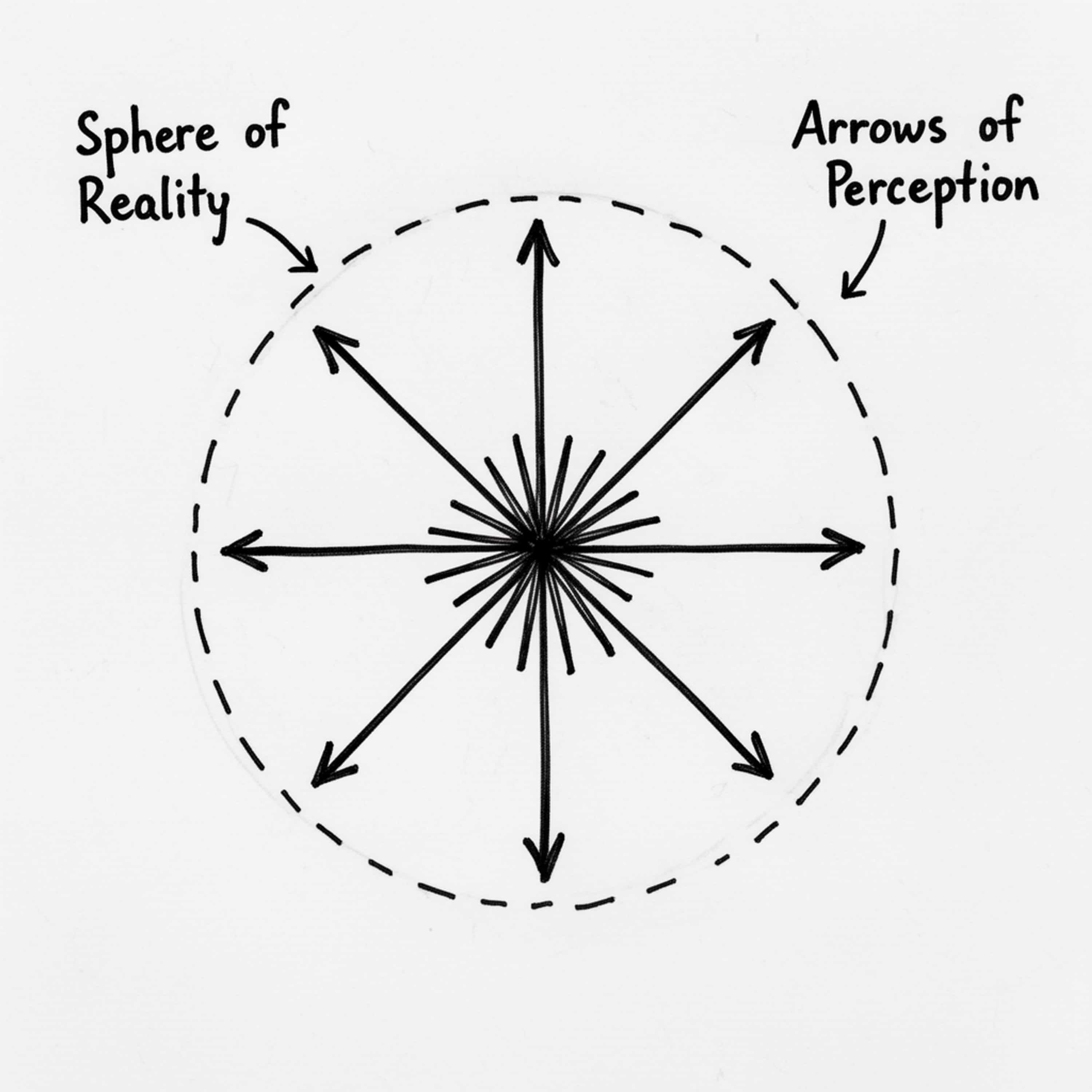
So, here’s the thing I want you to sit with for a moment: you are always, always at the center of your own reality. Not in a self-centered “the world revolves around me” way — that’s not what I mean. I mean, in a literal, inescapable sense. Every single thing you perceive gets filtered through your own mind, your own senses, your specific biology. You’ve got this… um, this apparatus, this body and brain, and it’s the only window you have on the world.
Toye Oyelese
I remember my first year working in Canada — imagine, I’d practiced medicine in Nigeria for years, so sure, English was familiar, but suddenly I was in a clinic in rural Alberta and… let’s say, I realized how much interpretation happens inside the mind. Patients used dialects and slang I’d never heard. Words I thought I knew became almost foreign. I’d hear them, I knew what they were supposed to mean, but my brain did this odd thing — it kind of put them through a filter, and sometimes I’d just draw a complete blank. Not because I didn’t know English, but because my mind just… didn’t map the sound to the meaning anymore. And I’d stand there for a split second longer than I meant to, trying to make sense. Sort of embarrassing, actually. But it made me realize, even with something as basic as language, everything I experience is reconstructed inside my head.
Toye Oyelese
That goes for everything — sound, sight, touch, all of it. When someone says something, you don’t actually hear their words as they are; you hear the vibration, your eardrum reacts, then your nervous system sends a signal, and finally — your brain? It decides what you think you heard. Same with sight. We don’t see what's "out there"; we see a version our brains are making from light bouncing off objects. Even touch — ah, that's just your nerves sending pressure and temperature signals up the chain. We are interpreters trapped in a box we can’t step outside of. And honestly, sometimes we forget just how thick the walls are.
Chapter 2
The Myth of Shared Reality
Toye Oyelese
Now, I know — there’s always this temptation to say, “Well, come on, Toye, look, we all seem to agree on stuff, right?” Like, we can perform surgery together, I mean — thank goodness. We build bridges that don’t fall down. We play music and we somehow stay more or less in sync. Isn’t that proof we experience the same reality? But here’s where, I think, we trick ourselves a little. Those things, they show coordination, yes — but not sameness of experience. Coordination just means we function well enough together, right? Not that my “red” is your “red,” or that the pain I feel is in any way the pain you feel.
Toye Oyelese
“Shared reality” — it’s, um, it’s a convenient assumption. It helps us cooperate, which is nice. But at the deepest level, it’s not something we can ever actually verify. You can’t step out of your own skin and double-check, “yep, I see the world just the way you do.” It’s not possible. As much as I want to believe I truly "get" what's happening inside my patient’s mind when they describe their pain or their fear — I mean, I might resonate with it, based on my own experience, but I can't access theirs directly. Even in those moments where someone looks at you and you just know, “this person gets it” — well, that’s still your interpretation at the center.
Toye Oyelese
And misunderstandings — ah, they become almost inevitable. When we assume too much overlap in our realities, that's where social trust gets tricky. I think about couples who finish each other’s sentences for years, then suddenly hit a patch where everything feels off; or teams that seem perfectly aligned until a tiny miscommunication throws everything sideways. It’s not that we suddenly changed — it’s that the myth of completely overlapping experience was always a myth. We just got reminded. So we muddle through, using our best, human-sized tools for empathy and communication.
Chapter 3
Accepting and Expanding Your Sphere
Toye Oyelese
So, you’re locked in — what then? Should we just throw up our hands? “That’s it, that’s my little bubble, I’ll just stay here?” Well, no — and this is where I, hmm, get a little prickly with that old “think outside the box” cliché. Because honestly, there’s no such thing. There’s only inside the box. You can’t escape your own epistemic position. I mean, you’re—you're always going to be inside your own head, for better or worse. But here’s what’s actually possible: you can grow your box, make it bigger, push at the edges.
Toye Oyelese
You can expand what’s inside, deepen what you understand, let in more experiences. And that, to me, is not just comforting, but empowering. Like, when I first came to Canada, I used to imagine I’d just have to break out of my old ways of thinking to really belong here. Thought I needed to escape myself to become “Canadian enough,” whatever that means. But what I realized — and this took a while, and a fair bit of messing up — is that real growth didn’t come from leaping out of my box and pretending I was someone else. No, the breakthroughs came from throwing myself deeper into listening to people here, learning their worries, their cultures, making mistakes and asking what I’d missed. Over time, the walls got less confining, not because I broke through them, but because the box itself expanded.
Toye Oyelese
So, it’s not about chasing a totally objective truth outside yourself. It’s about pushing at your boundaries — stretching them bit by bit so your reality gets richer and wider. Once you accept that you can’t escape your vantage point, you can focus that energy on actually growing it. And, you know, sometimes the box contracts too, when we withdraw or close off, but that’s a story for another time — or, well, maybe a future episode.
Toye Oyelese
That’s probably enough deep thinking for one day. Next time, I want to show you the diagram I drew… what, twenty-five years ago now? — and what it finally means to me. Maybe you’ll see your own experience in it. Until then, keep noticing the walls and, if you can, give them a gentle nudge.