7 - Contact and Resonance
What really happens when two people connect? In this episode, Dr. Toye Oyelese explores the idea of resonance—how we interpret signals from others within our own perceptual boundaries, and why true merger or shared experience is ultimately impossible. Discover the practical implications for communication and understanding.
This show was created with Jellypod, the AI Podcast Studio. Create your own podcast with Jellypod today.
Get StartedIs this your podcast and want to remove this banner? Click here.
Chapter 1
The Nature of Contact
Toye Oyelese
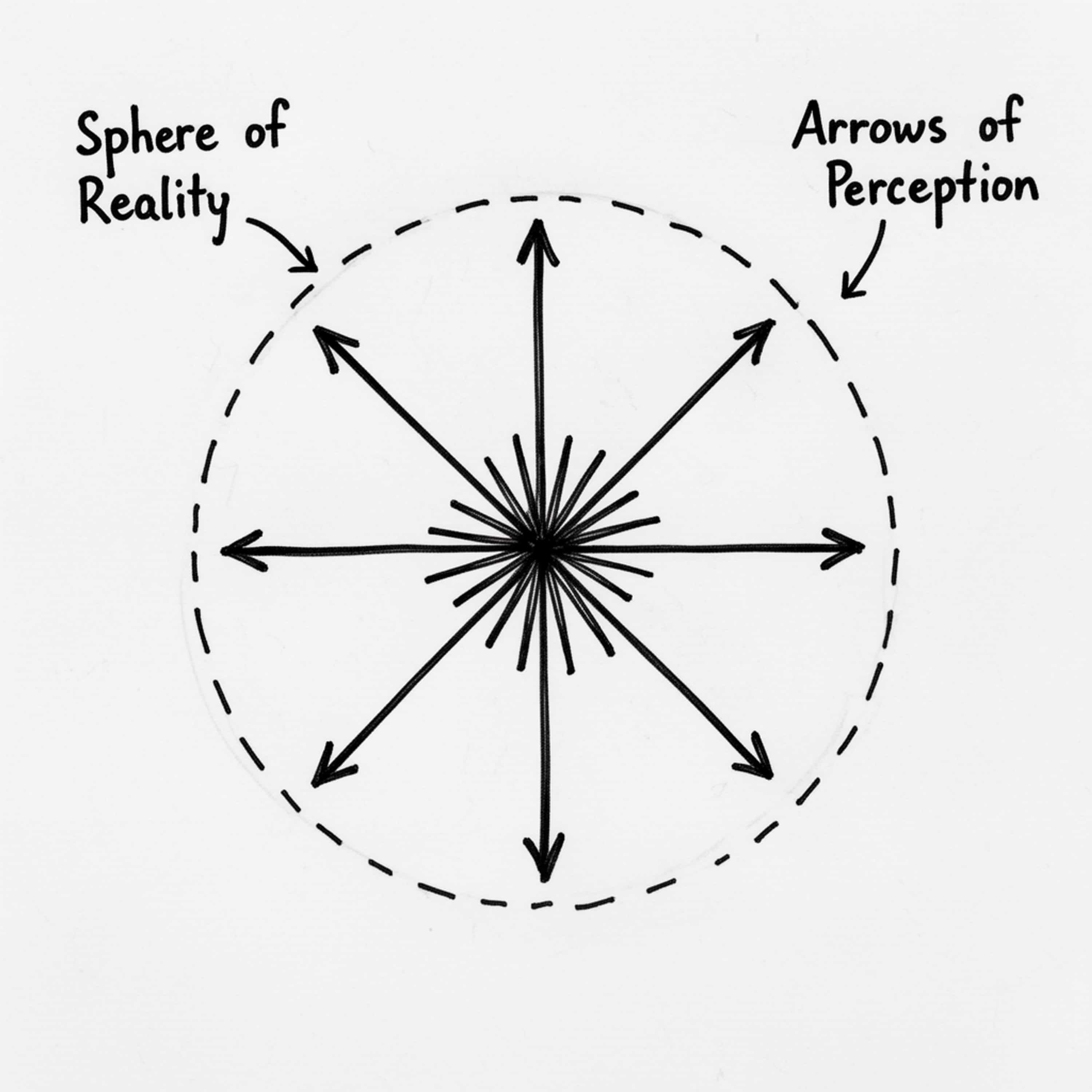
Welcome back, everyone, to The Sphere of Reality. I’m Toye Oyelese, and today we’re diving into something a little tricky, a little subtle—what it really means when we say two people connect. See, last time we talked about expanding your sphere, the way having more 'surface area' ups your odds of bumping into new experiences, new people. But what’s actually going on at that boundary when you do bump into somebody else? Is it blending together—like, two orbs melting into one? I... well, I used to picture it that way, years back, but that’s not quite it. Let’s start with the basics. Each of us, you, me—everyone—stuck squarely at the center of our own experience.
Toye Oyelese
No matter how close I get, I can’t just hop into your perception and poke around. Doesn’t matter if we spend years together: your reality’s your own, and mine is mine. I ran up hard against this early in my Canadian days, actually. Moving halfway around the world, expecting—well, maybe hoping—that eventually, I’d see things just like my patients did, or that they’d “get” where I was coming from without gaps. But I realized, no matter how long I lived in Canada, my eyes, my culture, my starting point—they shaped what I noticed, what I missed. I couldn’t become someone else. But I could—sometimes—get my experience to rhyme with theirs, if that makes sense. So that’s what I want to dig into: if genuine fusion isn’t possible, then what exactly is going on when we do make contact?
Chapter 2
Resonance, Not Merger
Toye Oyelese
Let’s zero in on this idea of resonance. It’s not about merging or dissolving boundaries. Instead, it’s—well, let’s get practical—a set of signals crossing a line, and then being interpreted on the other side. Imagine you say something to me. The words—sound waves—travel through the air. Maybe you wave hello—a gesture, a signal in the light. You send a text, or write a note. Those signals leave you, bounce over to the edge of your sphere, and then they land inside mine. But what arrives is never the whole of your reality—it’s just the message, and I’ve got to make sense of it inside my own system, with my own mental dictionary. I’ll never hear exactly what you meant, only my interpretation of the sounds. Same with anything: what I see isn’t “your” meaning, it’s my construction of the signals. And this goes both ways. We coordinate, we work with a sort of “good enough” understanding. There’s this classic bit: you and I both look at the sky. We both call it blue. Now, are we seeing the same blue? I mean—we assume so, we don’t argue about it, and we move on. But can I really step back and check if your blue is the same as mine? I can’t. Neither can you. My blue is forever filtered through my machinery, yours through yours. Mutual agreement—that’s useful, it helps us cooperate—but it’s not proof of sameness.
Chapter 3
The Limits and Power of Approximate Understanding
Toye Oyelese
So where does this leave us? Well, if true, complete sharing isn’t possible—if we’re always interpreting, never directly receiving—are we just stuck with misunderstandings? Not at all. This, to me, is the heart of things. Sure, perfect one-to-one understanding is a fantasy. But “close enough to build something together”—that’s both possible and powerful. Day to day, that’s how we function. Think about your workplace, your home, even sitting in a clinic with me—or, heck, explaining a diagnosis that I still triple-check before I say it—what we’re relying on is that our mutual signals are close enough for the job at hand. But here’s the catch: assuming we’ve ‘got it’ can lead us astray. I’ve seen it dozens of times.
Toye Oyelese
Just the other month, I had a patient who nodded along as I explained a care plan—seemed to understand everything. But when he came back, it was clear he’d misunderstood a step. Not because of lack of effort or smarts, but because our signals—my words, his interpretations—didn’t match as closely as we both assumed. That’s the gap resonance can leave. So what do we do about it? Well, recognizing our limits clarifies things—it helps me ask, “How did that land for you?” rather than assuming. It invites real curiosity, a willingness to check and re-check, not just move on autopilot. Communication isn’t about getting it ‘right’ once—it’s an ongoing tuning process, more jazz than symphony. And honestly, I think that’s freeing, not isolating. It takes the pressure off the need for perfect understanding, and opens up space for better questions, better listening. That’s where real collaboration happens.
Toye Oyelese
So—next time you’re trying to connect, try asking yourself: am I checking for resonance, or just assuming we’re on the same page? Because that single step—asking, checking, being open to the slight misalignments—can make contact a lot more meaningful. That’s all for today, but in our next episode, we’ll look at what actually unfolds after contact—what it means to establish ongoing exchange and the three routes it can take. As always, thank you for listening to The Sphere of Reality.