4 - Antevalence and the Edges of Reality
This episode explores the intriguing notion of 'antevalence'—the unexperienced flux that lies just beyond awareness. We'll unpack why this boundary matters, how meaning emerges, and what it looks like when your sphere of reality expands or contracts.
This show was created with Jellypod, the AI Podcast Studio. Create your own podcast with Jellypod today.
Get StartedIs this your podcast and want to remove this banner? Click here.
Chapter 1
What Is Antevalence?
Toye Oyelese
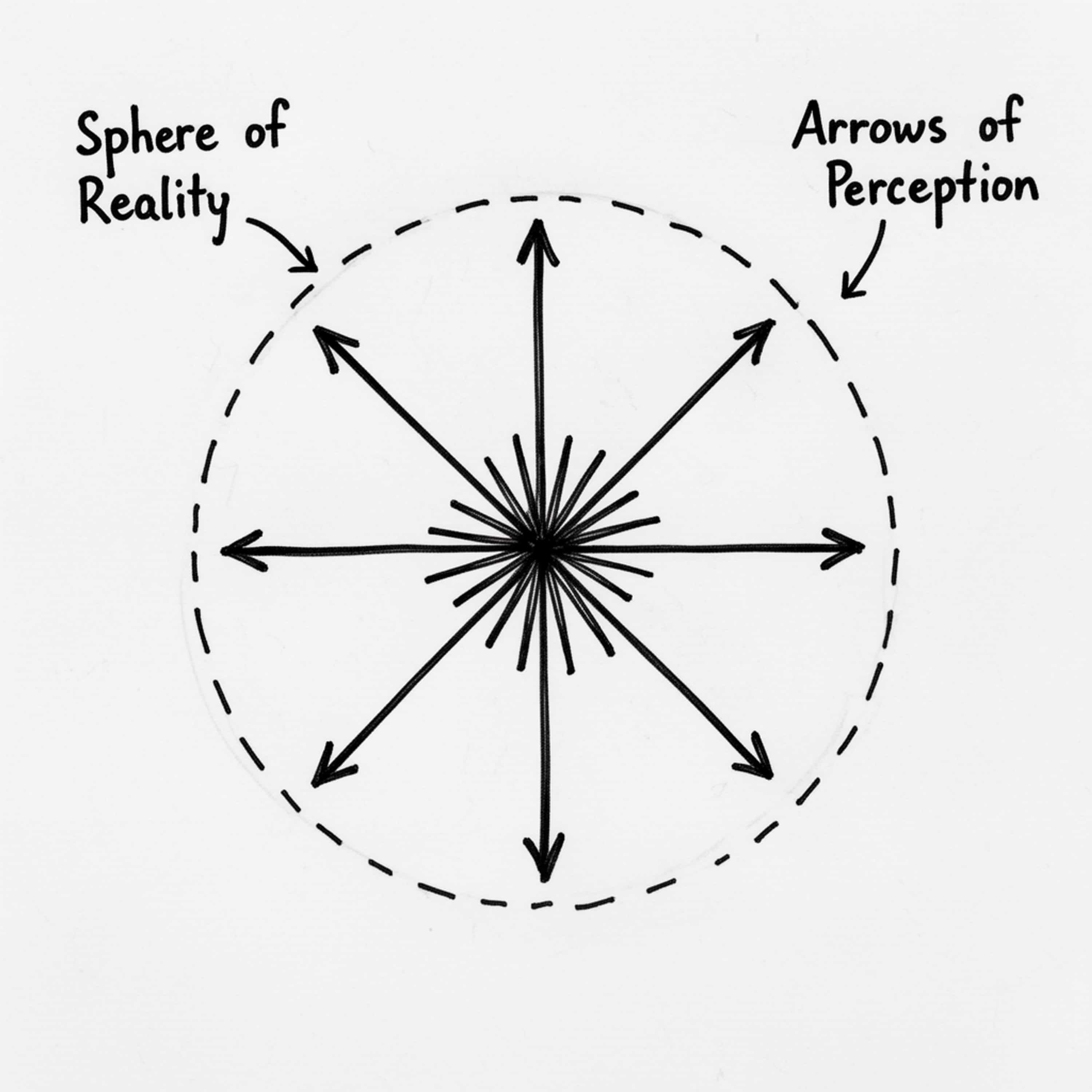
Welcome back to The Sphere of Reality. I'm Toye Oyelese, and if you've listened to the earlier episodes, you know by now that we always start with the same strange picture—you're at the center of your own sphere, and there's that dashed boundary, kind of mysterious, always shifting depending on where your attention and action go. But, let's poke at something we haven't really addressed yet: what actually sits just past that dashed line? That space no one ever talks about? So today, I want to introduce a word for it—it's antevalence.
Toye Oyelese
It's a bit of a mouthful, I know. "Ante" means before, and "valence," well, it's about value or meaning. So antevalence is, in a sense, what stands before meaning even exists. This isn't chaos—at least, not in that Hollywood, everything-explodes kind of way. It's not drama and tumult. It's just...undifferentiated change. Flux. Stuff that, for you, has not been shaped, or noticed, or ordered in any way. It's existence before you've got your hands—or your awareness—on it. Here's where it gets a bit tricky and maybe a touch frustrating: you can never truly experience antevalence directly. The paradox, and I checked three dictionaries to make sure I don't mess this up—any time something catches your attention, the very act of noticing is already an act of ordering.
Toye Oyelese
As soon as it moves even a toe inside your awareness, it's gone from flux into meaning. You can't stand outside yourself and grab a fistful of pure meaninglessness, because as soon as you try, you're giving it meaning. It's like trying to look at your own eyeball without a mirror—not really possible. So antevalence is always just at the edge of reach. The second you reach it? Poof, it’s ordered. It’s no longer antevalence. That’s the weird thing—it's like chasing the horizon, you never quite arrive. But it's important to recognize that this frontier exists because it changes how we relate to growth, to experience, and to what’s possible in our lives.
Chapter 2
The Boundary Between Order and Flux
Toye Oyelese
Now, let’s linger a bit more on this boundary—because it isn't just a fence drawn in the sand. It's dynamic, a place where your personal sense of order presses up against this ocean of flux, this antevalence. If you picture your reality as a sphere—and we've been coming back to this image since episode one—it’s like your own little island of meaning, floating in a sea of everything you haven't noticed yet. And the size of that island is always shifting. I remember when I was running my wellness clinic back in the day—somewhere between treating depression and, say, teaching Traditional Chinese Medicine (TCM) principles that augment treatment.
Toye Oyelese
I found myself constantly bumping into the limits of what I’d actually learned in medical school. Conventional family medicine, especially then, was very resistant to pushing the boundary. You sort of showed up, dispensed advice, and kept within the safe little beachhead of what everyone agreed was “ordered.” But health isn't that neat. The more we poked around in people’s lived experiences, the more I realized I was stepping into these unordered, often uncertain spaces—no tidy guidelines, plenty of flux. And I’ll be honest, it felt like walking right up to that dashed line of the sphere. Sometimes, actually, it felt like I was toeing right over it. And when I did that, it wasn’t always comfortable, but that's how the practice and, really, my sense of what medicine could be actually grew.
Toye Oyelese
That’s the thing about this boundary: it's not static. You aren’t defending a fixed castle wall—you’re sort of extending your order, bit by bit, into the unknown, sometimes even just by asking different questions, or staying present with unfolding uncertainty. It's noisy at the edge, you know? The further out you reach, the messier it feels—but that’s where the raw material for new meaning comes from. And sometimes you pull things in, making them part of your reality. Other times, when you step back or give up, that newly ordered part we worked so hard to create quietly slips back into the flux—no drama, just... gone. So for all of us, whatever we call our field, that's the daily dance: making and unmaking meaning at the edge between order and antevalence.
Chapter 3
Expansion and Contraction of Reality
Toye Oyelese
So what does it actually look like when your reality expands or contracts? Well, expanding the sphere really means pulling more of that antevalence into your realm of meaning—integrating something new, giving it order, and making it part of your lived, stable world. It's not just theory—this matters because, frankly, you can’t coast on past victories. For your sphere to stay stable, it has to be maintained actively. If you stop noticing, stop tending to the garden, so to speak, weeds pop up, things revert, and the order dissolves back into that flux outside. This isn't unique to medicine or awareness; it shows up all over daily life. Think about any skill—if you stop using it, it eventually becomes fuzzy, feels distant, almost as if it slips out of your grasp. That’s reality contracting: what was once part of your stable world becomes potential again, and then, slowly, undifferentiated change.
Toye Oyelese
The implication is kind of humbling, I think—meaning, significance, even stability don't just float there waiting for us. They’re built and rebuilt through action and attention. And it's a bit precarious, isn't it? What happens to the parts of our lives, or ourselves, when we stop engaging—when we let go of relationships, or hobbies, or questions we've been afraid to answer? Do they just fall away into antevalence, into flux? Can we even become meaningfully aware of antevalence, or is it—by definition—always going to be that unreachable, silent border? I’m not sure anyone really has a neat answer, but these are the sorts of questions that keep me curious, anyway. And maybe you too.
Toye Oyelese
As we wind down, just keep in mind—the edge of your reality isn’t somewhere far away, it’s always right where your interest and curiosity are bumping up against what you’ve never experienced before. To keep that edge alive, you have to step into it, bit by bit, with attention, with presence, and sometimes, yeah, with a little bit of nerve. Thanks for listening to The Sphere of Reality. I'm Toye Oyelese—and I hope you'll keep exploring the edge with me in the next episode.